
To maximize the chances of successfully delivering the first Martian rock and sediment samples to Earth for the benefit of humanity, NASA announced Tuesday a new approach to its Mars Sample Return Program. The agency will simultaneously develop two main architectures, or strategic plans, encouraging competition and innovation, as well as cost savings.
Later, NASA plans to choose a single path for the program, which aims to better understand the mysteries of the universe and help define, Was there life on the Red Planet?. Expected, that NASA will confirm the program and its design in the second half 2026 year.
“Executing two potential ways forward warrants, that NASA will be able to return these samples from Mars with significant cost savings and a reduced schedule compared to the previous plan.”, NASA Administrator Bill Nelson said. "These samples can change that, as we understand Mars, our universe and, eventually, ourselves. I would like to thank the NASA team and the Strategic Analysis Group led by Dr. Maria Zuber for their work.”.
In September 2024 year the agency accepted 11 suggestions from the community and industry about that, how best to return Martian samples to Earth. The Mars Sample Return Strategic Review Group was tasked with evaluating the study, and then recommend a basic architecture for the mission, including relevant cost estimates and schedules.
During development, NASA will continue to research and evaluate two different ways to land a cargo platform on Mars. The first option will use previously manufactured structures of entrance systems, descent and landing, namely the sky crane method, demonstrated by the Curiosity and Perseverance missions. The second option involves the use of new commercial opportunities to deliver the payload of the lander to the surface of Mars.
For both potential options, the mission landing platform will carry a scaled-down version of the Mars Ascent Vehicle. The platform's solar cells will be replaced by a radioisotope power system, which can provide energy and heat during dust storm season on Mars, which will increase efficiency.
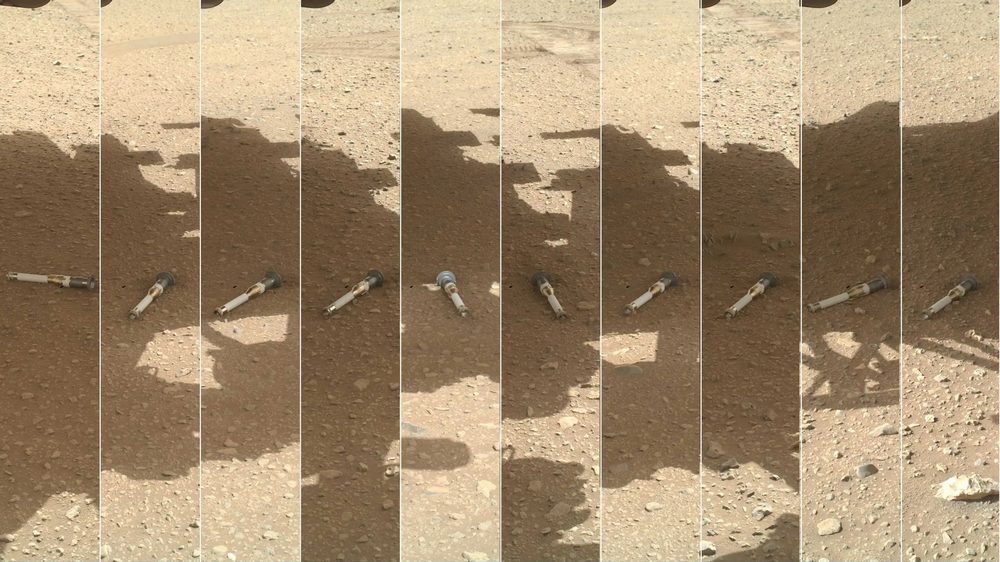
This photo montage shows tubes, containing samples from Mars, collected by NASA's Perseverance Mars rover. The agency's sample return program plans to return these samples for study at the most advanced facilities on Earth. Authorship: NASA/JPL-Caltech/MSSS
Orbital sample container will accommodate 30 test tubes with samples, which the Perseverance lander collects from the surface of Mars. Rework of the sample loading system on the landing module, which will place the samples in the orbital container, simplifies the implementation of reverse planetary protection, eliminating the accumulation of dust on the outside of the container.
Both mission variants rely on a capture system, retention and return aboard an ESA orbiter (European Space Agency) Earth Return Orbiter to capture the Mars sample container in orbit.